Quick answer
Capital Gains Tax is charged on your profit when you sell or give away an asset such as a second home, shares or crypto. For 2026/27 you pay nothing on the first £3,000 of gains. Above that, the rate is 18% on the part of your gain that fits inside your basic rate band and 24% on the rest. Use the calculator above to see your own figure.
Key facts
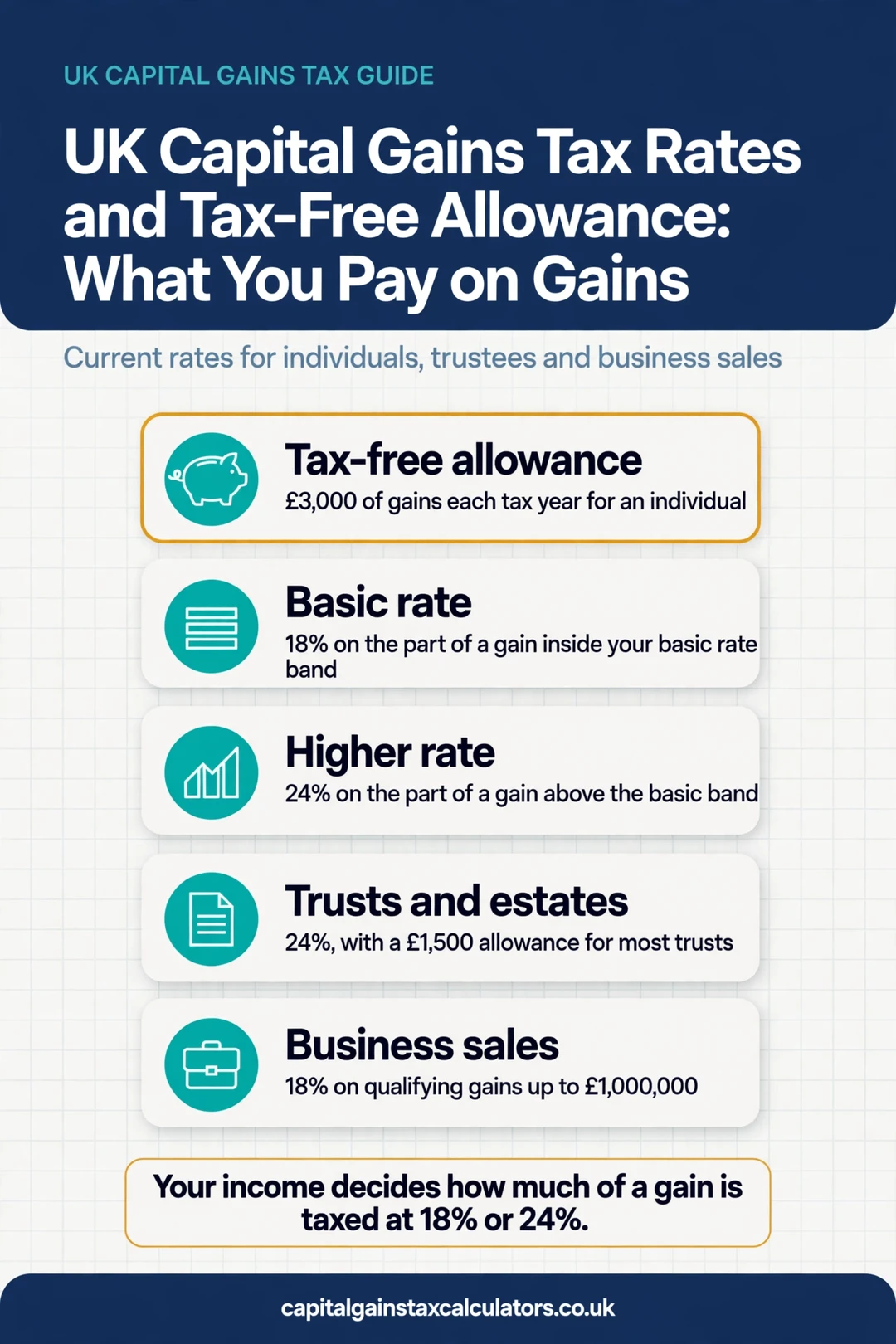
- The annual exempt amount (tax-free allowance) is £3,000 for 2026/27, or £1,500 for most trusts.
- Rates are 18% and 24% for individuals, on every asset type including residential property.
- Your income decides the rate. The basic rate band is £37,700, and your income above the £12,570 Personal Allowance uses it up first.
- Gains on UK residential property must be reported and paid within 60 days of completion.
- Your main home, ISAs, cars, gilts and Premium Bonds are normally free of Capital Gains Tax.
How Capital Gains Tax is worked out
Capital Gains Tax (CGT) is a tax on the profit, not on the sale price. HMRC only looks at the gain, which is what you sold for minus what it cost you, then applies reliefs, losses and your allowance. The calculator above follows the same order HMRC uses, and shows each step so you can check it.
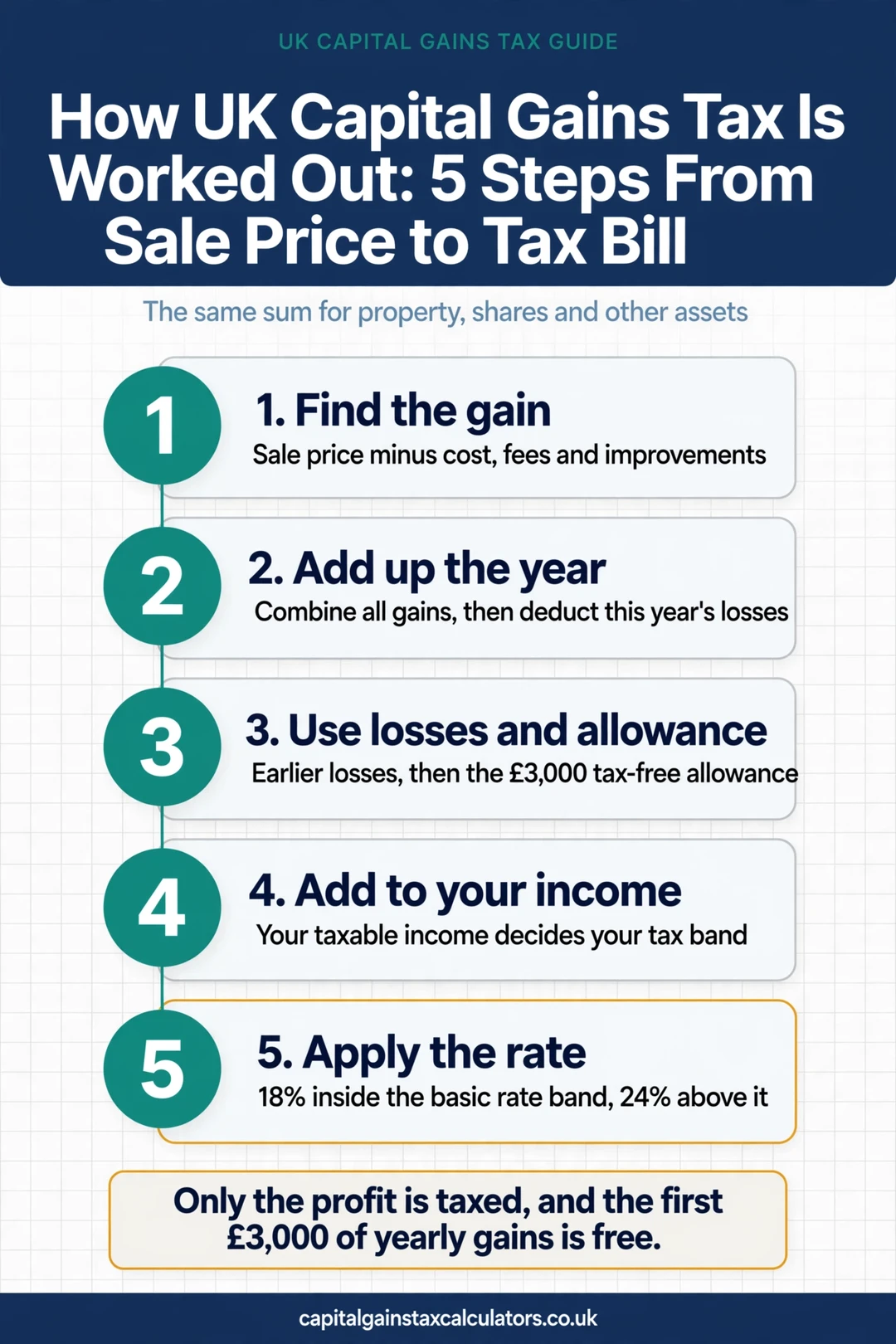
- Work out the gain on each asset. Take the sale price (or market value if you gave it away) and deduct what you paid, plus buying costs, selling costs and money spent on lasting improvements.
- Add up your gains and losses for the tax year. The tax year runs from 6 April to 5 April. Losses from the same year come off first.
- Deduct losses carried forward. These can only reduce your gains down to the allowance, not below it.
- Deduct the annual exempt amount. This is £3,000 for 2026/27.
- Apply the rate. Add the taxable gain to your taxable income. The part that fits inside the £37,700 basic rate band is taxed at 18%, and the rest at 24%.
A worked example with shares
Say you sold shares for £30,000 that cost you £14,000, with £40 dealing costs on the way in and £80 on the way out. You earn £42,000 a year.
Worked example
Shares sold for a gain, on a £42,000 income
- Gain: £30,000 minus £80 selling costs, minus £14,000 cost, minus £40 buying costs = £15,880.
- Allowance: £3,000 comes off, leaving a taxable gain of £12,880.
- Your taxable income is £29,430 (income of £42,000 less the £12,570 Personal Allowance), so £8,270 of the basic rate band is still free.
- £8,270 is taxed at 18% and £4,610 at 24%.
- Capital Gains Tax: £2,595.
The same sale on a lower income would use more of the cheaper band. On an income of £20,000, for example, the whole taxable gain would fall inside the basic rate band and the bill would be £2,318. That is why the calculator asks for your income.
Which calculator do you need?
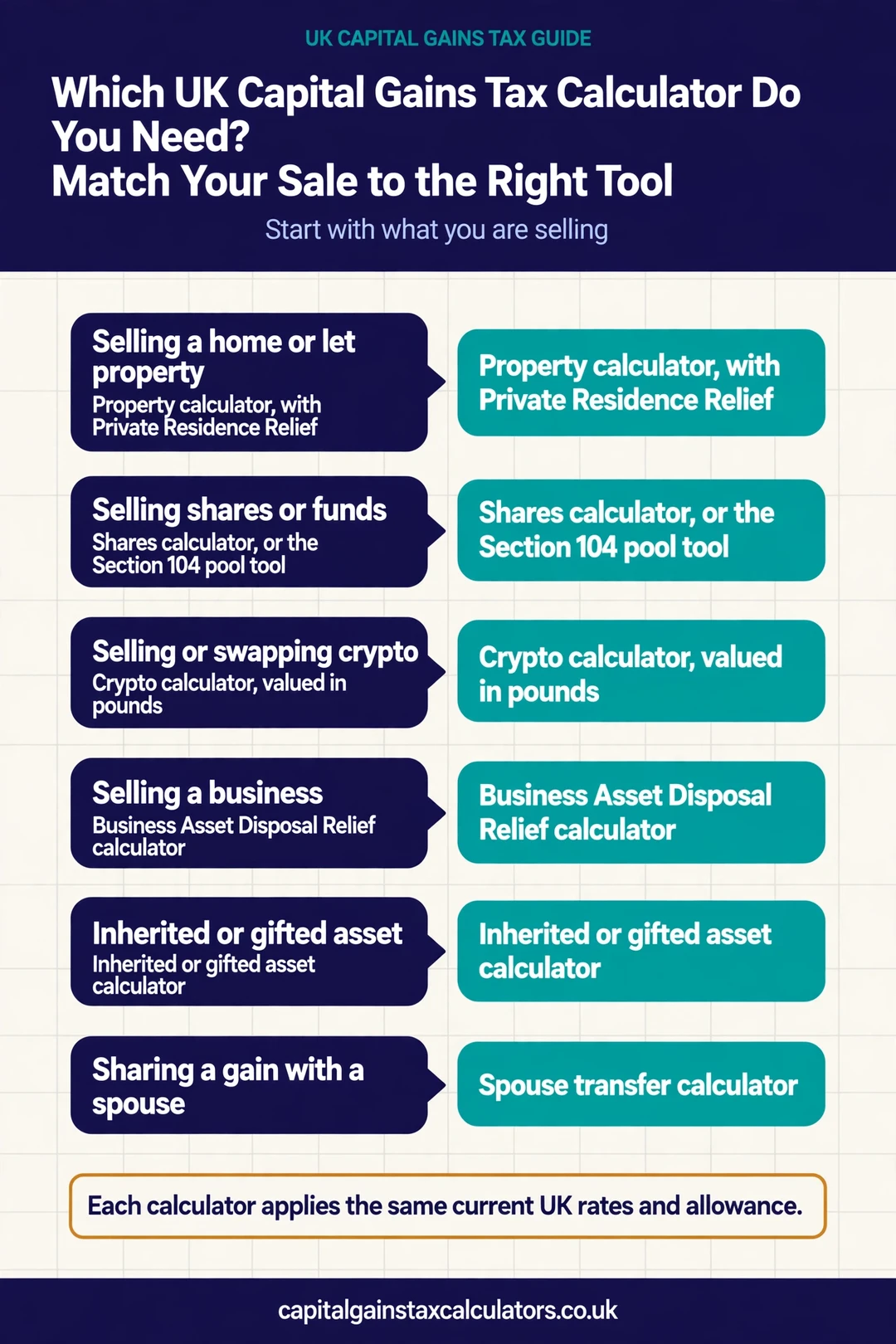
The master calculator at the top of this page covers a single sale of property, shares, crypto or a personal item. For anything more specific, use one of the focused calculators below. Each one asks only the questions that matter for that situation.
| You want to know | Use this calculator |
|---|---|
| Tax on selling a second home or buy-to-let | Property CGT calculator |
| Tax on a share sale | Shares CGT calculator |
| Gains on shares bought at different times | Section 104 share pool calculator |
| Tax on selling or swapping crypto | Crypto CGT calculator |
| Relief on a home you lived in, then let or left | Private Residence Relief calculator |
| Tax when you sell a business | Business Asset Disposal Relief calculator |
| Tax on a house you inherited | Inherited property calculator |
| Tax on giving an asset away | Gifted asset calculator |
| Saving tax by sharing an asset with a spouse | Spouse transfer planner |
| Your report-and-pay date for a property sale | 60-day deadline calculator |
| Whether to sell now or after 5 April | Sell now or wait calculator |
Rates and allowance for 2026/27
The same two rates apply to nearly every asset. Residential property used to carry higher rates than shares, but the rates were aligned part-way through the 2024/25 tax year, so a property gain and a share gain are now taxed alike. The main exceptions are gains that qualify for Business Asset Disposal Relief, and gains made by trustees and personal representatives.
| Who or what | Rate for 2026/27 | Annual exempt amount |
|---|---|---|
| Individuals: gains within the basic rate band | 18% | £3,000 |
| Individuals: gains above the basic rate band | 24% | £3,000 |
| Gains qualifying for Business Asset Disposal Relief | 18% (up to a £1,000,000 lifetime limit) | £3,000 |
| Trustees (most trusts) | 24% | £1,500 |
| Personal representatives of an estate | 24% | £3,000 for the year of death and the next two tax years |
CGT rates are the same in England, Scotland, Wales and Northern Ireland. Scottish taxpayers use the rest-of-UK basic rate band when deciding which CGT rate applies, rather than the Scottish income tax bands. For a full breakdown, see our guide to Capital Gains Tax rates and the Capital Gains Tax allowance.
What counts as a sale for Capital Gains Tax
You “dispose of” an asset when you sell it, give it away, swap it for something else or receive compensation for it. A gift counts as a sale at market value, even though no money changes hands. The main exceptions are gifts to a husband, wife or civil partner you live with, and gifts to charity, which are normally tax free.
Assets that commonly create a gain include:
- A second home, buy-to-let or land (see CGT on property).
- Shares, funds and investment trusts held outside an ISA (see CGT on shares).
- Cryptoassets (see CGT on crypto).
- Business assets and shares in your own company.
- Personal possessions worth £6,000 or more, such as antiques, jewellery and art, but not your car.
Reporting and paying: the deadlines that matter
When and how you report depends on what you sold. Missing a deadline can lead to interest and penalties, so check the right route before you file.
| What you sold | How to report | Deadline |
|---|---|---|
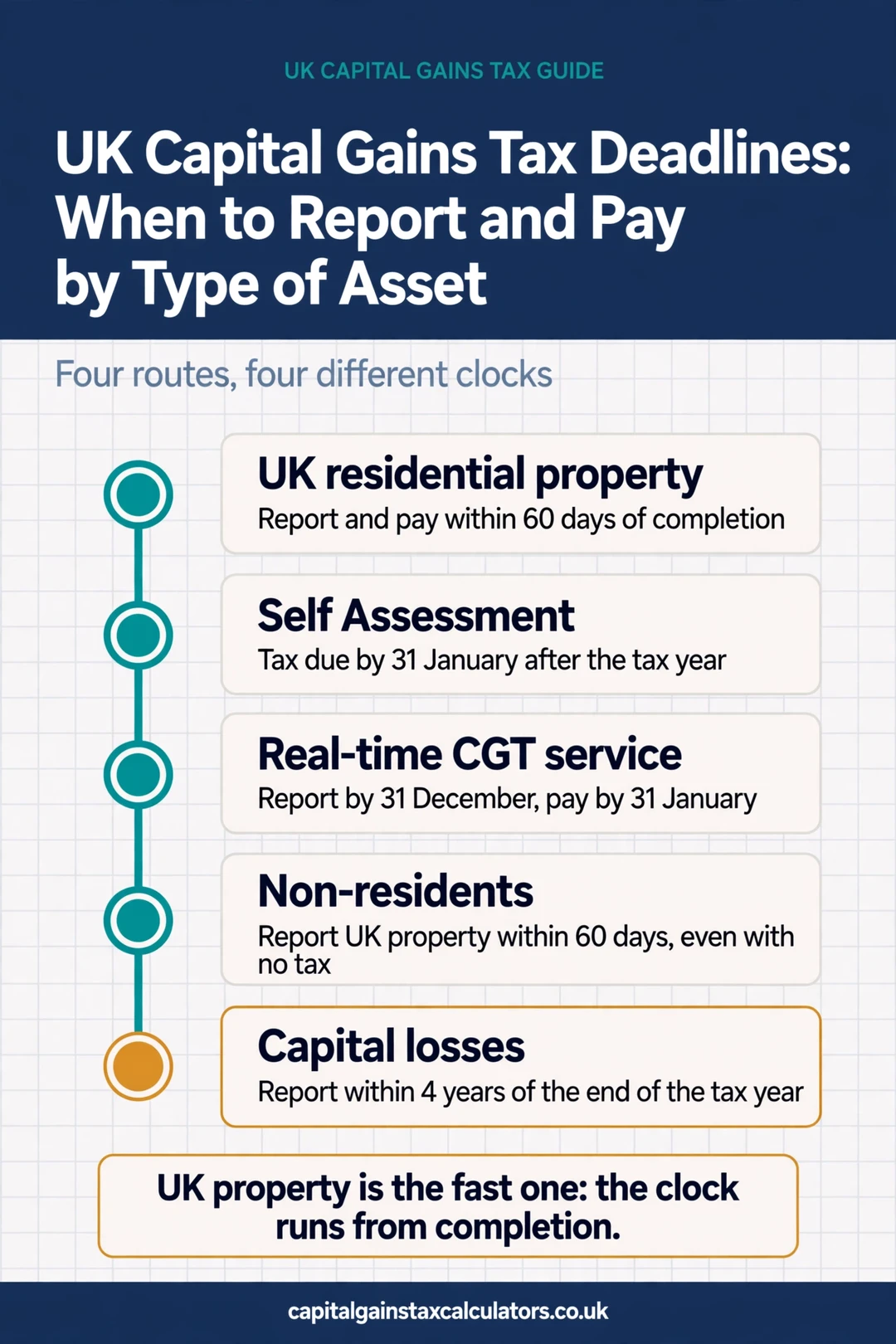
| UK residential property, with tax to pay | CGT on UK property return | Within 60 days of completion |
| Other assets, and you file Self Assessment | Self Assessment tax return | Tax due by 31 January after the tax year ends |
| Other assets, and you do not file Self Assessment | Real-time Capital Gains Tax service | Report by 31 December after the tax year ends, and pay by 31 January |
| Any UK property or land, if you are non-resident | CGT on UK property return | Within 60 days, even if no tax is due |
If your total sale proceeds for the year are over £50,000 and you are registered for Self Assessment, you must report on your tax return even if the gain is under the allowance. Our guides on how to report Capital Gains Tax and reporting a property sale walk through each route step by step.
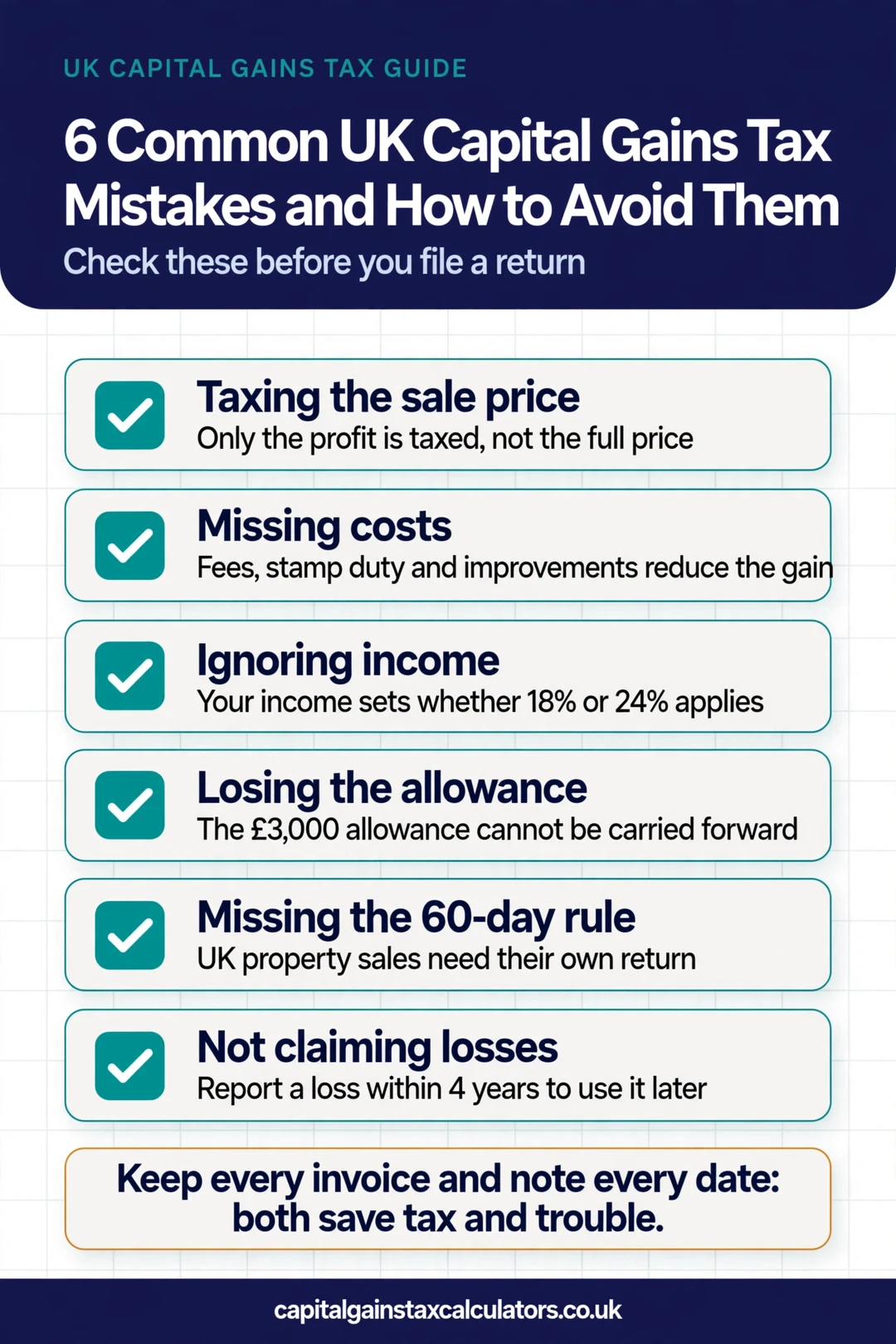
Common mistakes the calculator helps you avoid
- Using the sale price as the gain. Only the profit is taxed, after your costs.
- Forgetting buying and selling costs. Stamp duty, legal fees, estate agent fees and dealing charges all reduce the gain.
- Ignoring your income. The same gain can be taxed at 18% for one person and 24% for another.
- Assuming the allowance carries forward. The £3,000 is use-it-or-lose-it. Unused allowance disappears on 5 April.
- Missing the 60-day property deadline. A residential property sale needs its own return, separate from Self Assessment.
- Not reporting losses. A loss only helps you if you claim it within 4 years of the end of the tax year of the sale.
What to do next
- Run your numbers through the calculator at the top of the page, or pick the closer match from the table above.
- Gather your paperwork: purchase and sale dates, completion statements, fees and receipts for improvements.
- Check whether a relief applies, such as Private Residence Relief or Business Asset Disposal Relief.
- Work out how and when to report using our reporting guide.
- If you can choose when to sell, try the sell now or wait calculator.
Frequently asked questions
How much Capital Gains Tax will I pay?
It depends on your gain, your income and the allowance. After the £3,000 allowance, gains are taxed at 18% up to the top of your basic rate band and 24% above it. The calculator above works out your exact figure.
What is the Capital Gains Tax allowance for 2026/27?
The annual exempt amount is £3,000 for individuals and personal representatives, and £1,500 for most other trustees. You only pay tax on gains above it, and unused allowance cannot be carried forward.
Do I pay Capital Gains Tax when I sell my main home?
Usually not. Private Residence Relief covers the time you lived there and the final 9 months of ownership. You may owe tax if you let part of it, used part for business, or the grounds are larger than 5,000 square metres.
Are the rates different for property and shares?
No. Individuals pay 18% or 24% on both. Property used to have higher rates, but they were aligned in the 2024/25 tax year.
Is this calculator accurate?
It uses the 2026/27 rates and bands published by HMRC and shows every step. It is an estimate for a typical case. Complex situations, such as non-residents, company sales or unusual reliefs, need specialist advice.
Do I have to report a gain if it is under the allowance?
If you are in Self Assessment and your total sale proceeds are over £50,000, yes. Otherwise a gain below the allowance does not usually need reporting, apart from some UK property cases for non-residents.
Can I reduce Capital Gains Tax legally?
Yes. You can use your allowance every year, transfer assets to a spouse, offset losses, claim reliefs and time sales around 5 April. Our guide to reducing Capital Gains Tax covers each option.
What happens if I sell at a loss?
A loss can be set against gains in the same tax year or carried forward without a time limit, but you must report it to HMRC within 4 years of the end of the tax year. See capital gains tax losses.
Does the calculator store my figures?
No. The calculation runs in your browser, and nothing is saved unless you choose to email the result to yourself. Even then we do not keep your address or your numbers.
Who pays Capital Gains Tax on an inherited asset?
Nobody pays tax simply for inheriting. Tax arises when the executors or beneficiaries sell, based on the increase in value since the date of death. See inherited property and CGT.
Official sources
- GOV.UK: Capital Gains Tax overview
- GOV.UK: Capital Gains Tax rates
- GOV.UK: Capital Gains Tax allowances
- GOV.UK: Work out if you need to pay Capital Gains Tax
- GOV.UK: Report and pay your Capital Gains Tax
Related guides and calculators
This page gives general information for UK taxpayers and is not tax advice. Capital Gains Tax rules can change and your own circumstances matter. Check the latest rules on GOV.UK or with a qualified tax adviser before you act.